
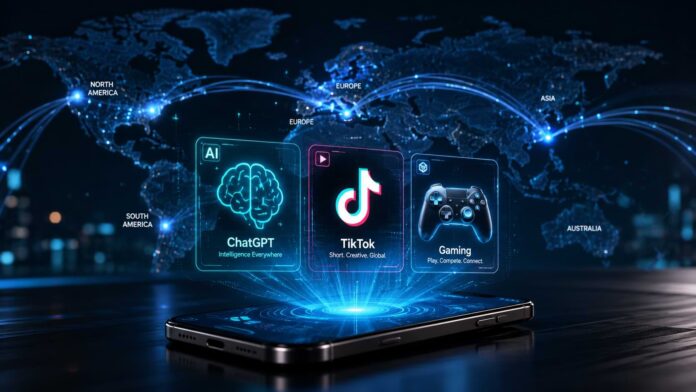

The global mobile ecosystem is experiencing an unprecedented structural shift. If you want to understand consumer behavior, user acquisition, and regional market penetration, you must look at the raw distribution of the world’s Most Popular Apps and Most Downloaded Apps.
Historically dominated by social media networks and short-form video feeds, the modern app marketplace has completely bifurcated. Today, long-standing entertainment channels are actively fighting for real estate against automated, generative cognitive utilities and friction-free mobile games.
This comprehensive data-driven industry analysis uses certified store intelligence (Appfigures, AppMagic, and Sensor Tower) to map out exactly which applications are dominating user handsets across both major platforms, key categories, and critical regional economies.
The Macro Trajectory: Most Downloaded Apps of the Decade (2020–2026)
To understand how drastically human habits have evolved, look at the historical timeline of the single most downloaded application worldwide year-on-year. We have shifted from core pandemic-era survival and communication tools to entertainment hooks, and finally, into the era of specialized artificial intelligence.
 [2020] TikTok (850M Installs)   ──► Early Pandemic Global Entertainment Spike
   ▼
 [2021] TikTok (656M Installs)   ──► Short-Form Content Engine Domination
   ▼
 [2022] TikTok (672M Installs)   ──► Complete Death of Chronological Feeds
   ▼
 [2023] Instagram (696M Installs)──► Meta Absorbs the Short-Form Reels Shift
   ▼
 [2024] TikTok (773M Installs)   ──► Peak Legacy Social Media Attention Loop
   ▼
 [2025] ChatGPT (770M Installs)  ──► The Inversion to Cognitive Utilities
   ▼
 [2026] ChatGPT (Projected Top)  ──► Complete Workflow Ecosystem Integration
| Active Calendar Year | Top App Worldwide | Metric Volume (Downloads) | Dominant Strategic Trend |
| 2026 (Ongoing) | ChatGPT | Tracking >800M | Agentic Task Execution & Workflow Automation |
| 2025 | ChatGPT | 770 Million | The Mainstream Explosion of Conversational AI |
| 2024 | TikTok | 773 Million | Algorithmic Attention Retention & Content Loops |
| 2023 | 696 Million | Meta’s Short-Form Video Counter-Offensive | |
| 2022 | TikTok | 672 Million | Global User Attention Lock-In via Personal Feeds |
| 2021 | TikTok | 656 Million | Post-Lockdown Social Isolation Compensation |
| 2020 | TikTok | 850 Million | Early Pandemic Global Isolation Boredom Wave |
Top 15 Most Downloaded Apps Globally
The definitive macro leaderboard displays total storefront metrics across both the Apple App Store and Google Play Store combined.
| Rank | Application | Global Downloads (Millions) | Primary Category | Parent Publisher |
| 1 | ChatGPT | 770 | Artificial Intelligence | OpenAI |
| 2 | TikTok | 644 | Social Media | ByteDance |
| 3 | 521 | Social Media | Meta Platforms | |
| 4 | 431 | Social Media | Meta Platforms | |
| 5 | 405 | Communication | Meta Platforms | |
| 6 | Temu | 363 | Shopping / B2C | PDD Holdings |
| 7 | Google Gemini | 354 | Artificial Intelligence | |
| 8 | CapCut | 334 | Video Editing | ByteDance |
| 9 | Block Blast | 303 | Mobile Gaming | Hungry Studio |
| 10 | Telegram | 297 | Communication | Telegram FZ-LLC |
| 11 | Snapchat | 275 | Communication | Snap Inc. |
| 12 | Threads | 274 | Social Media | Meta Platforms |
| 13 | Roblox | 262 | Mobile Gaming | Roblox Corporation |
| 14 | WhatsApp Business | 247 | Business Utility | Meta Platforms |
| 15 | Free Fire | 247 | Mobile Gaming | Garena |
Platform Segmentation: Most Popular Apps by OS
The operating system split reveals a clear socioeconomic divide. Users on Apple’s iOS ecosystem demonstrate significantly higher disposable income behaviors, prioritizing workflow utilities and native tools. Meanwhile, Google Play Store metrics highlight massive global download volumes across emerging economies.
1. Most Popular iOS Apps
| Rank | Application Name | Platform Downloads (Millions) | Core Utility Focus |
| 1 | ChatGPT | 217 | Generative AI Workflows |
| 2 | Google Gemini | 164 | Multimodal AI Assistance |
| 3 | Threads | 130 | Text-Based Real-Time Feeds |
| 4 | CapCut | 109 | Mobile Video Post-Production |
| 5 | Google Maps | 104 | Spatial Navigation & Local Search |
| 6 | Temu | 103 | Direct-to-Consumer E-Commerce |
| 7 | 97 | Native Mobile Information Retrieval | |
| 8 | TikTok | 96 | Short-Form Content Streams |
Check in detail: Top Most Downloaded iPhone Social Media Apps
2. Most Popular Google Play Apps
| Rank | Application Name | Platform Downloads (Millions) | Core Utility Focus |
| 1 | ChatGPT | 553 | Automated Content & Task Execution |
| 2 | TikTok | 549 | Algorithmic Media Delivery |
| 3 | 456 | Visual Networking & Reels Consumption | |
| 4 | 378 | Legacy Social Media Infrastructure | |
| 5 | 340 | Universal Mobile Messaging standard | |
| 6 | Temu | 261 | Gamified Discount Retail Supply Lines |
| 7 | Snapchat | 233 | Ephemeral Micro-Communications |
| 8 | Telegram | 227 | Cloud-Based Encrypted Channels |
Cross-Border Intel: Regional Leaderboards
When you strip away global averages, localized rankings expose regional socioeconomic realities, infrastructural priorities, and varying user needs.
1. Most Popular Apps in India
While ChatGPT maintains an incredible utility footprint, Instagram firmly dominates the Indian subcontinent with 165 million downloads. However, the real tactical story is the explosive growth of instant delivery infrastructure (Q-Commerce) to bypass urban logistics hurdles.
[The Indian Urban Shift]
Physical Grocery Run (Metro Gridlock)   ──► 90 Mins of Inefficient Commuting
Hyper-Local Q-Commerce (Blinkit/Zepto) ──► 10 Mins Direct to Doorstep Delivery
| Rank | Application | Downloads (Millions) | Strategic Driver / Market Insight |
| 1 | 165 | The absolute undisputed cultural hub, driven heavily by Reels adoption. | |
| 2 | ChatGPT | 152 | Massively deployed by developers, students, and regional content operations. |
| 3 | JioHotstar | 111 | The streaming superpower is capturing the eyes of major live cricket broadcasters. |
| 4 | Kuku TV | 106 | Explosive growth of pocket-sized, audio-first regional fiction storytelling. |
| 5 | Meesho | 102 | Capturing massive market share by removing middleman costs in Tier 2/3 markets. |
| 6 | 91 | Maintains a massive, deeply rooted legacy infrastructure footprint. | |
| 7 | PhonePe | 82 | The absolute monarch of peer-to-peer digital transaction volume via UPI. |
| 8 | Blinkit | 82 | Reshaping urban commerce via immediate hyper-local dark store delivery. |
Most Popular Apps Around The World
Top trending mobile applications dominating global digital ecosystems in 2026.
United States
America’s mobile ecosystem reflects a fierce AI competition alongside dominant social and communication platforms.
| # | App | Users |
|---|---|---|
| 1 | ChatGPT | 74M |
| 2 | Google Gemini | 44M |
| 3 | TikTok | 39M |
| 4 | Threads | 34M |
| 5 | 29M | |
| 6 | Block Blast | 28M |
Spain
Spain’s app usage focuses heavily on communication platforms and digital government infrastructure.
| # | App | Users |
|---|---|---|
| 1 | ChatGPT | 12M |
| 2 | Google Gemini | 8.3M |
| 3 | Temu | 7.5M |
| 4 | TikTok | 5.5M |
| 5 | Cl@ve | 5.4M |
| 6 | Threads | 5M |
Vertical Market Breakdown: Category Leaders
Grouping the Most Popular Apps by niche shows that consumers are abandoning generic web browsing to spend time inside dedicated, vertically organized application ecosystems.
1. Entertainment Apps
The definitive story here is the rapid disruption of traditional long-form video platforms (like Netflix) by hyper-compressed short video micro-drama suites (DramaBox, ReelShort), which serve original, episodic, fast-paced series built entirely for vertical orientations.
| Rank | App Name | Annual Volume (Millions) | Category Dominance Factor |
| 1 | Spotify | 215 | Global Music/Podcast Distribution Ecosystem |
| 2 | DramaBox | 178 | Micro-Drama Vertical Video Pipeline |
| 3 | ReelShort | 148 | Micro-Drama Vertical Video Pipeline |
| 4 | Netflix | 147 | High-End Long-Form Subscription VOD |
| 5 | Kuku TV | 121 | Audio-First Storytelling & Regional Podcasts |
| 6 | JioHotstar | 118 | Live Sports & Regional Indian Catalog Streaming |
2. Music & Audio Apps
| Rank | App Name | Annual Volume (Millions) | Monetization / Core Vector |
| 1 | Spotify | 215 | Advanced personal discovery engines (Discover Weekly) |
| 2 | StarMaker | 76 | Social gamified karaoke rooms & fan communities |
| 3 | DDMusic | 73 | Offline local audio indexing & media management |
| 4 | YouTube Music | 72 | Bundled subscriptions tied directly to premium video |
3. Shopping Apps
Direct-to-consumer mobile retail functions on an aggressive, ultra-efficient manufacturing-to-device loop. Temu and Shein continue to generate vast shipping quantities, altering typical consumer delivery expectations.
[The Retail Optimization Pipeline]
Factory Production Floor ──► Cross-Border Freight ──► Mobile User Purchase Terminal (Temu/Shein)
| Rank | App Name | Annual Volume (Millions) | Core Strategic Framework |
| 1 | Temu | 363 | High-Volume Gamified Factory-Direct Marketplace |
| 2 | Shein | 154 | Fast-Fashion Fast-Turnaround Supply Pipeline |
| 3 | Amazon Shopping | 141 | Established Western Prime Logistics Fulfillment |
| 4 | Meesho | 124 | Zero-Commission Social Selling across Tier 2/3 Regions |
4. Travel Apps
The transit vertical shows a distinct structural split: major multinational organizations manage cross-border hospitality and global journeys, while local networks handle urban public transport tracking.
| Rank | App Name | Annual Volume (Millions) | Real-World Operational Context |
| 1 | Uber | 137 | The undisputed global on-demand logistics standard |
| 2 | Airbnb | 66 | Peer-to-peer real estate rental monetizing network |
| 3 | Where is my Train | 63 | Offline regional railway indexing (Critical India utility) |
| 4 | inDrive | 62 | Algorithmic consumer-to-driver fare bidding grid |
5. Dating Apps
Dating platforms are rapidly specializing. While Tinder commands the largest broad acquisition volume, newer matching platforms focusing on cultural groups or custom audio features are scaling quickly.
| Rank | App Name | Annual Volume (Millions) | User Behavioral Persona |
| 1 | Tinder | 60 | Worldwide Casual Geo-Location Swipe Standard |
| 2 | Bumble | 28 | Female-Led Outbound Message Initiation Loop |
| 3 | FRND | 21 | Audio-First Vernacular Matches (Highly popular across Tier 2 India) |
| 4 | Badoo | 20 | Continental European and Latin American Social Networks |
The Mobile Gaming Evolution: 2014 vs. 2026
Evaluating the Most Popular Games category reveals a sharp transition away from basic, physics-based pastimes and toward high-end multiplayer titles that demand advanced mobile processors.
The Nostalgic Local Era (2014)
Back in 2014, mobile gaming was primarily a local, social ritual. Short study breaks were dominated by leaderboard challenges in Subway Surfers or gathering into small groups to create local Wi-Fi networks for chaotic multiplayer rounds of Mini Militia. These games were incredibly lightweight, loaded instantly on basic mobile processors, and never required premium graphics hardware or complicated virtual transactions. It was accessible, straightforward fun.
The Heavy Hardware Race (2018–2026)
This casual approach changed permanently with the launch of massive tactical properties like PUBG Mobile and Free Fire. Mobile gaming quickly grew out of passive time-killing and emerged as an intensive competitive export.
This functional shift altered smartphone buying habits entirely. Players could no longer compete effectively if their budget hardware stuttered or suffered from thermal frame drops during complex multiplayer matches. Today’s younger generation actively checks device hardware profiles—evaluating screen refresh rates, vapor cooling structures, and processing loops before choosing a phone.
Corporate Ecosystem Dominance: Top App Publishers
For the first time in mobile marketplace history, Google has bypassed Meta Platforms to secure the position of the world’s most dominant software publisher by gross acquisition volume.
[Publisher Share: Total Global Downloads]
 ├── Google: 2,654M Installs ──► Native Mobile Infrastructure Supremacy
 ├── Meta: 2,536M Installs   ──► Core Communication Network Monopolies
 └── ByteDance: 2,184M Installs──► Algorithmic Media Mastery
-
Google: 2,654 Million Downloads (Driven by system utilities, workspace management, and native productivity lines)
-
Meta Platforms: 2,536 Million Downloads (Maintaining structural monopolies over basic digital communication frameworks)
-
ByteDance: 2,184 Million Downloads (Dominating short-form creative ecosystems)
-
OpenAI: 1,006 Million Downloads (Achieving historic scale with single-service terminal products)
Regional App Culture Differences
United States
Main priorities:
- productivity
- AI
- creator tools
- premium subscriptions
India
Main priorities:
- affordability
- entertainment
- cricket streaming
- instant delivery
- UPI payments
China
Main priorities:
- super-app ecosystems
- integrated payments
- embedded commerce
- AI-enhanced marketplaces
Emerging Trends to Watch (2026–2028)
1. AI Agents Replacing Traditional Apps
Instead of opening:
- calculator
- translator
- scheduler
- email app
Users increasingly rely on AI assistants.
2. “Faceless Content” Explosion
AI tools are creating:
- automated reels
- AI voice channels
- synthetic influencers
- auto-generated stories
This may reshape:
- YouTube
- TikTok
- podcasting
- regional entertainment
3. Micro-Drama Addiction Economy
Apps like:
- DramaBox
- ReelShort
are proving users increasingly prefer:
- 60-second cliffhangers
- fast emotional pacing
- mobile-native storytelling
instead of traditional TV formats.
Fun App Facts
- The average smartphone user touches their phone thousands of times per day.
- Many users spend more total time inside apps than on traditional websites.
- Push notifications are engineered using behavioral psychology principles.
- Infinite scrolling removed the “stopping cue” humans normally experience with physical media.
- Mobile games now generate more revenue globally than console and PC gaming combined in many years.
Strategic Prediction
The next trillion-download platforms likely will not look like traditional apps at all.
The future appears to be moving toward:
- AI operating layers
- voice-first interaction
- autonomous task systems
- invisible computing
- hyper-personalized feeds generated in real time
The smartphone is gradually evolving from:
“A device containing apps”
into:
“A personalized cognitive operating system.”
The Final Takeaway: Navigating a Maturing App Marketplace
The latest global storefront data shows an undeniable truth for engineers, digital marketers, and tech founders: the era of basic, mid-tier single-purpose software utilities is over.
To survive in the current market, consumer applications must position themselves at one of two main structural points: either offer an Infinite Cognitive Frontier that leverages advanced AI models to actively save users time, or provide a Frictionless Abstract Escape like Block Blast that lets users step away from algorithmic feeds to enjoy simple, highly repeatable, and rewarding mechanical puzzles.
Frequently Asked Questions: Most Popular Apps 2026
1. What are the most downloaded apps in 2026?
As of early 2026, the global download charts have seen a historic shift. ChatGPT has climbed to the #1 spot globally, followed closely by Instagram and TikTok. Other top-tier downloads include:
-
CapCut (Video Editing)
-
Telegram
-
WhatsApp
-
Threads (Meta’s social platform)
-
Google Gemini (AI Assistant)
2. Which apps have the most monthly active users?
While new apps get the most downloads, “legacy” social platforms still dominate daily usage. The apps with the highest active user bases are:
-
Facebook: Over 3.2 billion users.
-
Instagram & WhatsApp: Tied at roughly 3 billion users each.
-
YouTube: 2.85 billion users.
-
TikTok: 2 billion users.
3. What are the top trending apps on the Apple App Store?
The Apple App Store is currently dominated by AI productivity tools and Utility apps. The top trending free apps include:
-
ChatGPT & Claude: Leading the AI assistant category.
-
Google Gemini: Rapidly rising as a native iOS competitor.
-
Canva: For AI-driven graphic and video design.
-
Temu & Meesho: Leading the global “budget” e-commerce trend.
4. Which is the most popular dating app in 2026?
Tinder remains the most downloaded dating app globally with over 630 million lifetime downloads. However, user preference is shifting based on intent:
-
Hinge: Currently ranked as the #1 app for those seeking serious relationships.
-
Bumble: The top choice for women-led interactions.
-
TimeLeft: A trending “offline-first” app for group dinners that gained massive popularity in early 2026.
5. Are AI apps replacing social media?
Not entirely, but usage habits are changing. While social media apps still command the most time spent (around 35% of mobile time), AI apps have seen a 200%+ increase in downloads year-over-year. People are now using AI assistants for tasks they previously would have searched for on social media or Google.
2026 App Leaders
| Category | Top App (Downloads) | Top App (Active Users) |
| Social Media | ||
| Messaging | ||
| AI / Assistant | ChatGPT | ChatGPT |
| Entertainment | TikTok | YouTube |
| Dating | Tinder | Tinder |
| Shopping | Temu | Amazon |



, historic rise to casual gaming shifts and regional trends, here is what billions of downloads tell us.)