

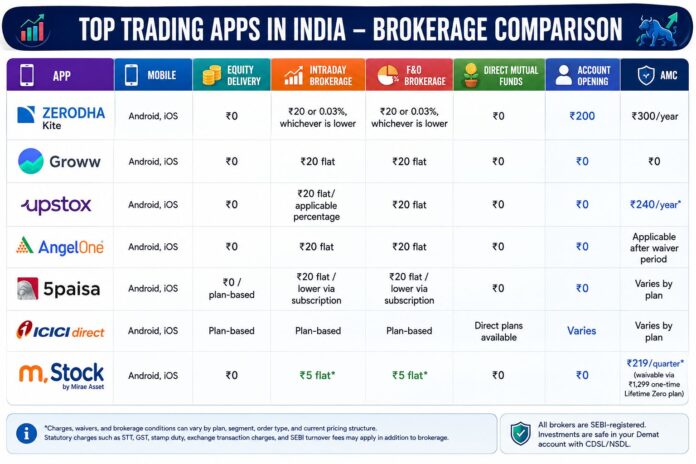

Choosing a trading app in India isn’t just about brand recognition anymore. Brokerage models, F&O pricing, and mutual fund charges vary significantly between platforms, and the “cheapest” app depends heavily on what you actually trade.
Below is a single-column, app-by-app breakdown covering each platform’s description, key features, pros, cons, platform availability, and brokerage costs across equity, F&O, and mutual funds.
1. Zerodha Kite
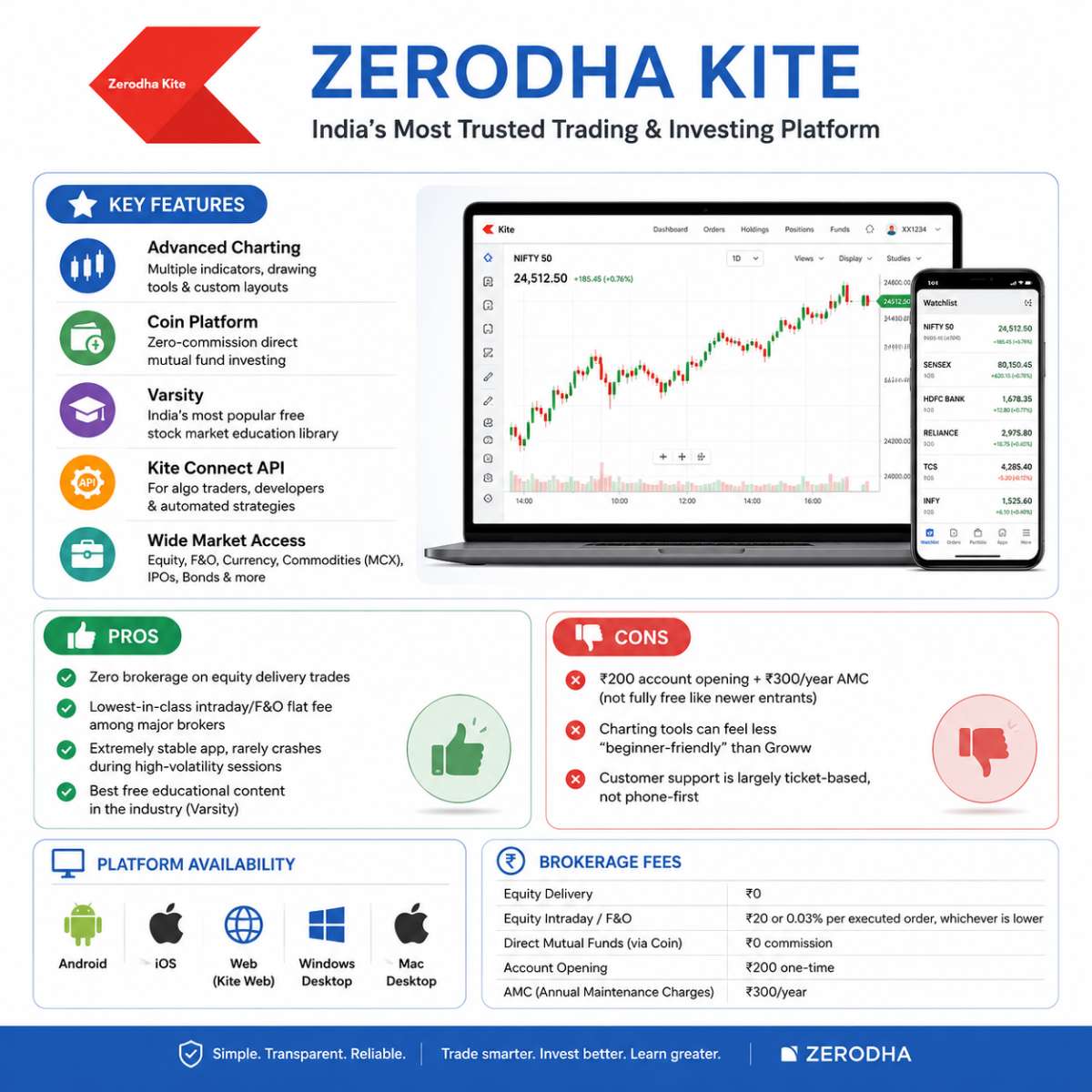
Description: India’s largest stockbroker by active client base, Zerodha has built its reputation on transparent, flat-fee pricing and a clean, no-frills trading experience. Kite is its flagship trading platform, paired with Coin for direct mutual funds and Varsity for free investor education.
Key Features:
- Advanced charting with multiple indicators and drawing tools.
- Coin platform for commission-free direct mutual fund investing.
- Varsity, one of India’s most popular free stock market education platforms.
- Kite Connect API for algo traders and developers.
- Supports equity, F&O, currency, commodities (MCX), IPOs, and bonds.
Pros:
- Zero brokerage on equity delivery trades.
- Competitive flat-fee pricing for intraday and F&O trading.
- Stable and reliable trading platform.
- Excellent free educational content through Varsity.
Cons:
- ₹200 account opening fee and ₹300 annual AMC.
- Charting tools may feel less beginner-friendly than Groww.
- Customer support is primarily ticket-based rather than phone-first.
Platform Availability: Android, iOS, Web (Kite Web), and Windows/Mac desktop.
Brokerage Fees:
- Equity Delivery: ₹0.
- Equity Intraday / F&O: ₹20 or 0.03% per executed order, whichever is lower.
- Direct Mutual Funds (via Coin): ₹0 commission.
- Account Opening / AMC: ₹200 one-time + ₹300/year.
2. Groww
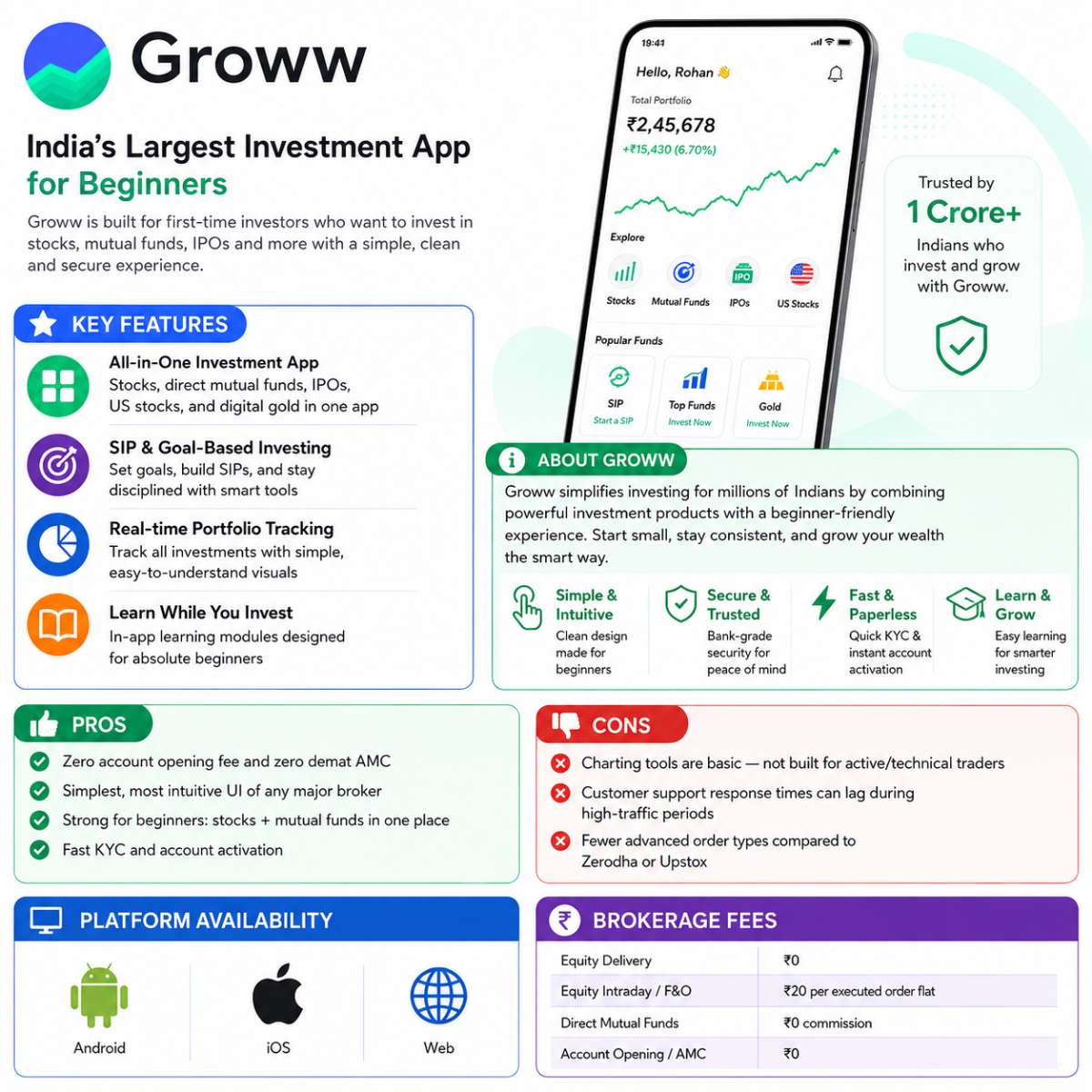
Description: Groww is one of India’s leading investment apps by active users, designed primarily for beginners investing in mutual funds and stocks. Its interface simplifies investing through a clean, mobile-first design.
Key Features:
- Unified platform for stocks, direct mutual funds, IPOs, US stocks, and digital gold.
- Simple SIP and goal-based investing tools.
- Real-time portfolio tracking with easy-to-understand visual breakdowns.
- In-app learning resources for beginners.
Pros:
- Zero account opening fee and zero demat AMC.
- Simple and intuitive user interface.
- Suitable for beginners who want stocks and mutual funds in one place.
- Fast KYC and account activation.
Cons:
- Charting tools are relatively basic and not designed for advanced technical traders.
- Customer support response times may increase during high-traffic periods.
- Fewer advanced order types compared with platforms such as Zerodha and Upstox.
Platform Availability: Android, iOS, and Web.
Brokerage Fees:
- Equity Delivery: ₹0.
- Equity Intraday / F&O: ₹20 per executed order, flat.
- Direct Mutual Funds: ₹0 commission.
- Account Opening / AMC: ₹0.
3. Upstox
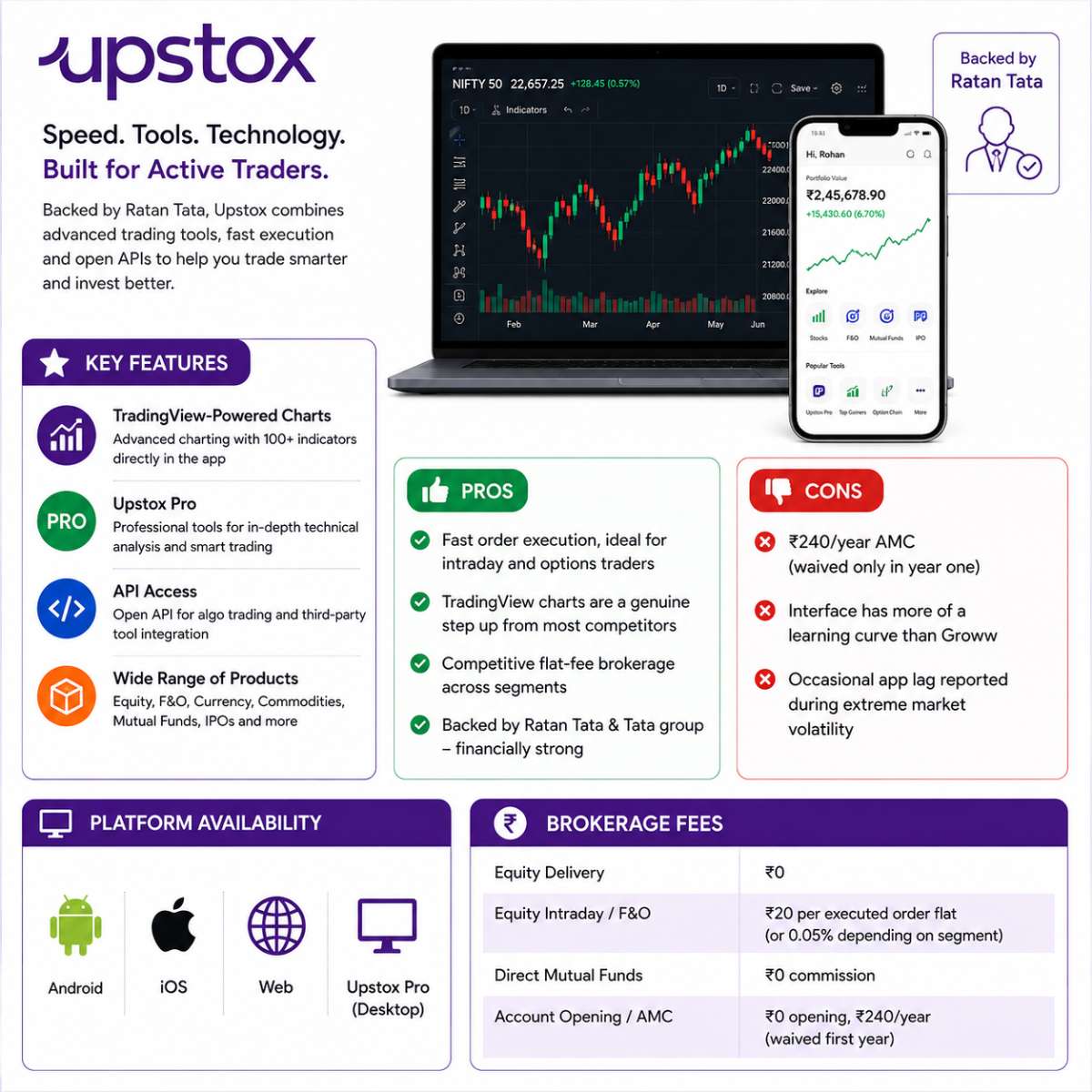
Description: Backed by Ratan Tata, Upstox positions itself as a trading platform focused on speed and advanced tools. It combines TradingView-powered charts with fast order execution and API access.
Key Features:
- TradingView charting integration.
- Upstox Pro for advanced technical analysis.
- API access for algo trading and third-party integrations.
- Supports equity, F&O, currency, commodities, mutual funds, and IPOs.
Pros:
- Fast order execution, making it suitable for intraday and options traders.
- TradingView charts provide advanced technical analysis capabilities.
- Competitive flat-fee brokerage across multiple segments.
- Strong financial backing, including investment from the Tata Group.
Cons:
- ₹240 annual AMC after the applicable waiver period.
- The interface has a steeper learning curve than Groww.
- Users may experience occasional app performance issues during periods of extreme market volatility.
Platform Availability: Android, iOS, Web, and Upstox Pro desktop.
Brokerage Fees:
- Equity Delivery: ₹0.
- Equity Intraday / F&O: ₹20 per executed order, flat, or applicable percentage-based charges depending on the segment.
- Direct Mutual Funds: ₹0 commission.
- Account Opening / AMC: ₹0 opening fee; ₹240/year AMC after the applicable waiver.
4. Angel One
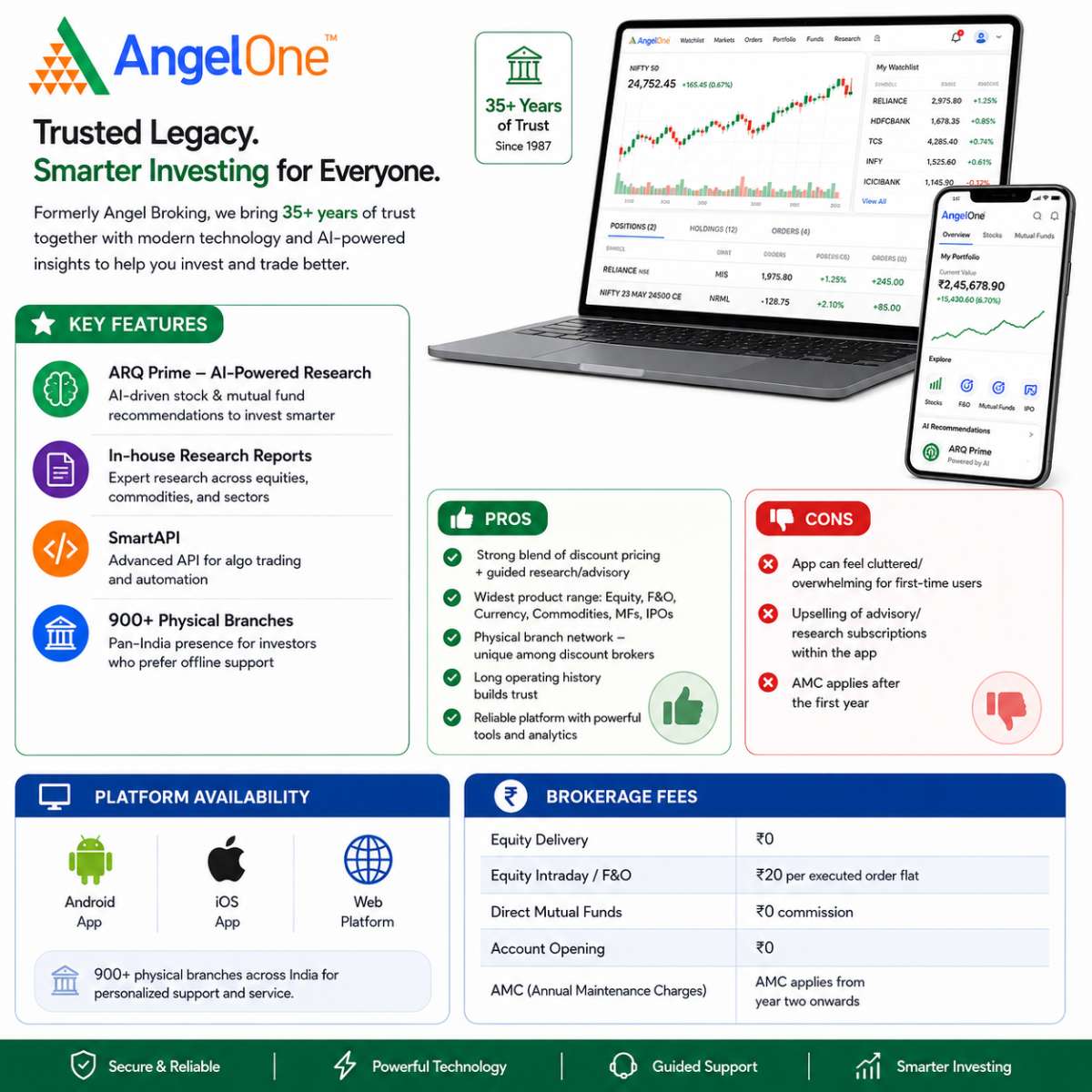
Description: Formerly known as Angel Broking, Angel One is one of India’s established brokerage firms. Founded in 1987, the company has transformed into a digital-first discount broker with AI-driven investment tools such as ARQ Prime.
Key Features:
- ARQ Prime for AI-powered stock and mutual fund recommendations.
- In-house research reports covering equities and commodities.
- SmartAPI for algo trading.
- Extensive physical branch network for investors who prefer offline support.
Pros:
- Combines discount pricing with research and advisory services.
- Wide range of products, including equity, F&O, currency, commodities, mutual funds, and IPOs.
- Physical branch network provides an additional support option.
- Long operating history provides an established track record.
Cons:
- The app can feel cluttered for first-time users.
- Advisory and research services may involve additional charges.
- AMC may apply after the applicable waiver period.
Platform Availability: Android, iOS, and Web.
Brokerage Fees:
- Equity Delivery: ₹0.
- Equity Intraday / F&O: ₹20 per executed order, flat.
- Direct Mutual Funds: ₹0 commission.
- Account Opening / AMC: ₹0 opening fee; AMC may apply after the applicable waiver period.
5. 5paisa
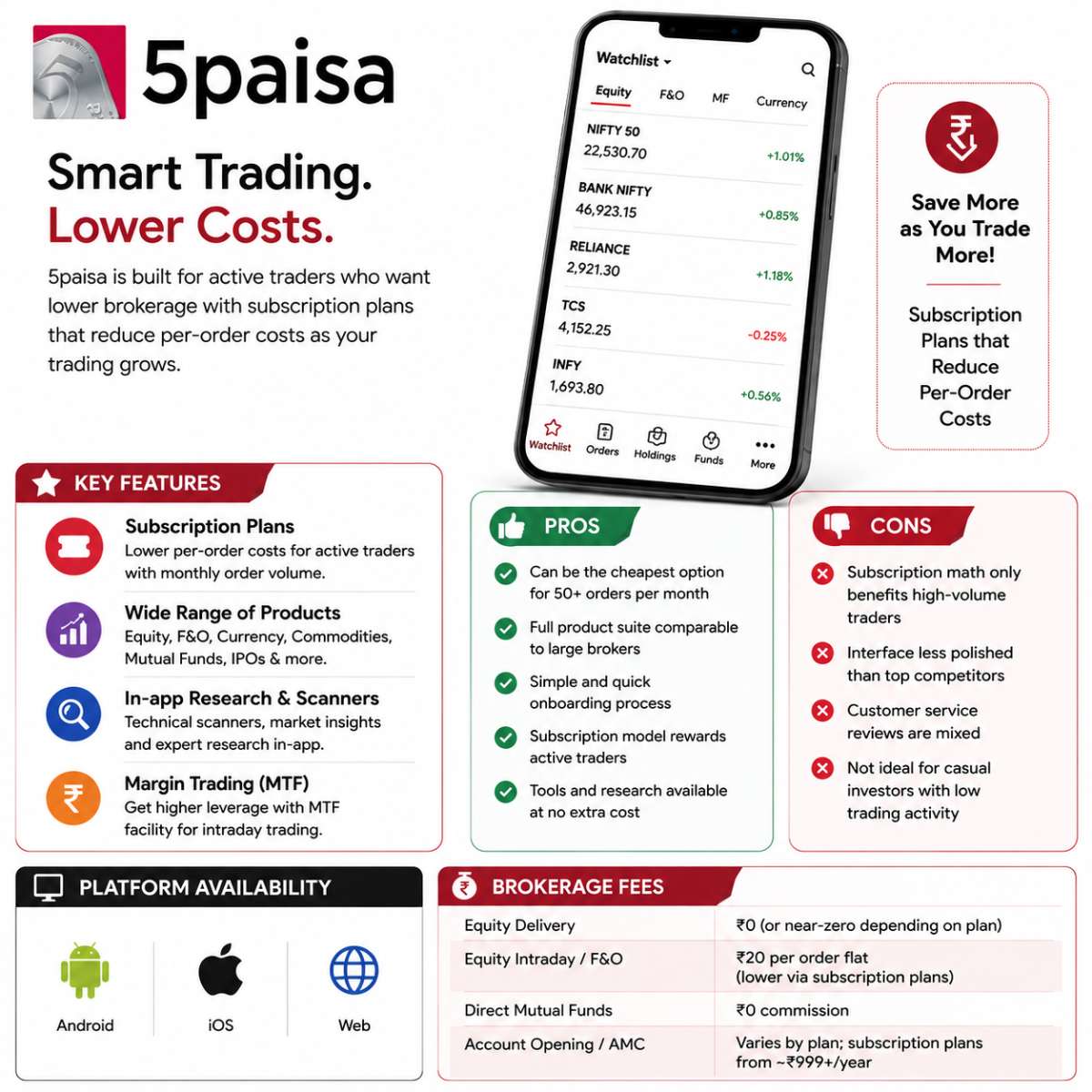
Description: 5paisa targets active and high-frequency traders with subscription-based pricing plans. These plans can reduce per-order brokerage costs for investors and traders who place a high number of orders.
Key Features:
- Subscription plans that can reduce per-order brokerage costs.
- Supports equity, F&O, currency, commodities, and mutual funds.
- In-app research tools and technical scanners.
- Margin Trading Facility (MTF).
Pros:
- Can be cost-effective for traders placing a high number of orders each month.
- Offers a broad range of investment and trading products.
- Simple onboarding process.
Cons:
- Subscription plans may not provide enough value for casual investors.
- Interface may feel less polished than platforms such as Zerodha, Groww, and Upstox.
- Customer service experience can vary.
Platform Availability: Android, iOS, and Web.
Brokerage Fees:
- Equity Delivery: ₹0 or near-zero, depending on the applicable plan.
- Equity Intraday / F&O: ₹20 per order, with lower rates available through certain subscription plans.
- Direct Mutual Funds: ₹0 commission.
- Account Opening / AMC: Varies by plan; subscription plans may start from approximately ₹999/year.
6. ICICI Direct
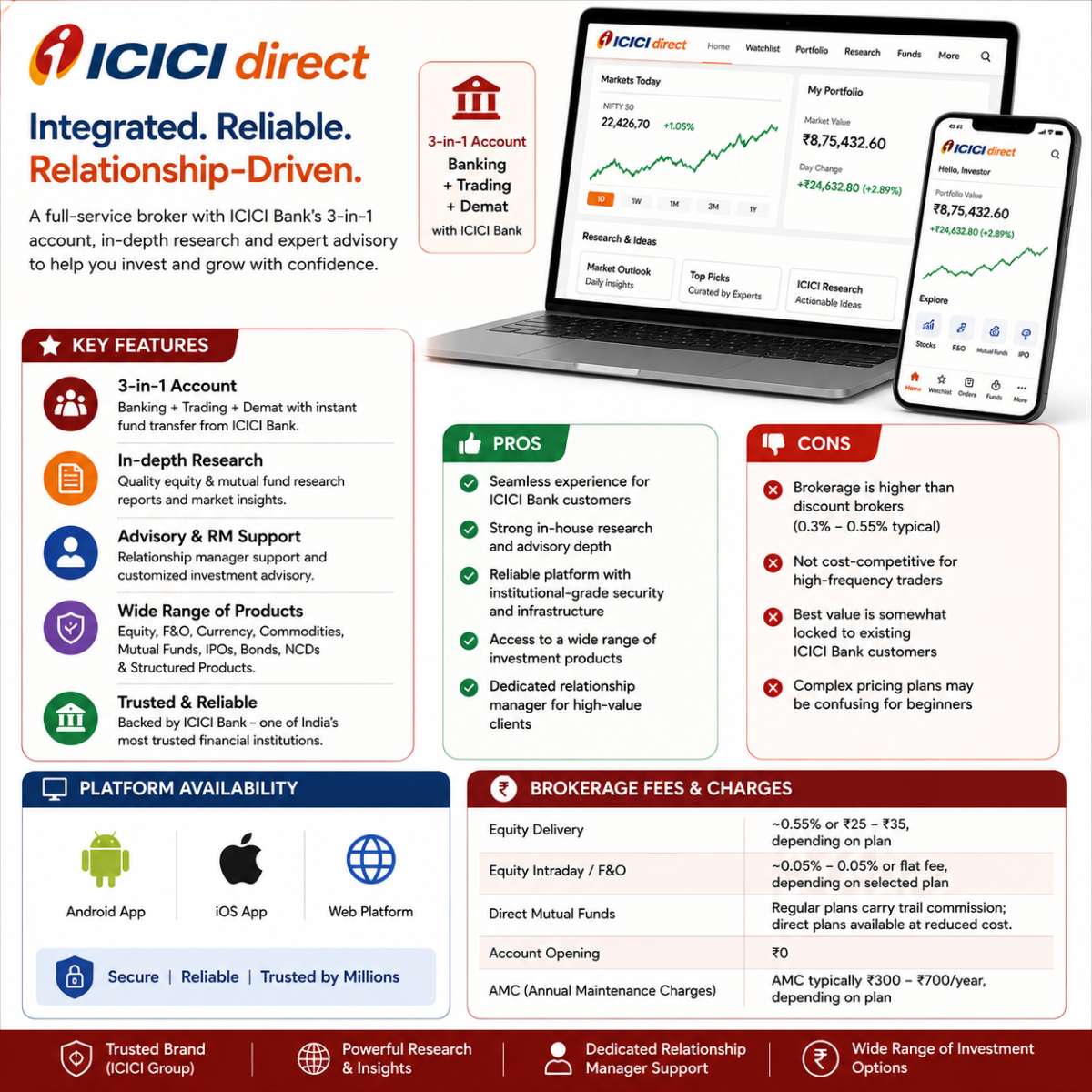
Description: ICICI Direct is a full-service brokerage platform built around ICICI Bank’s 3-in-1 account, combining banking, trading, and demat services. It is aimed at investors who value integrated banking, research, and advisory services.
Key Features:
- 3-in-1 account combining banking, trading, and demat services.
- Instant fund transfers through a linked ICICI Bank account.
- In-depth equity and mutual fund research reports.
- Advisory and relationship-manager support for eligible investors.
- Access to bonds, NCDs, and other investment products.
Pros:
- Seamless experience for existing ICICI Bank customers.
- Strong in-house research and advisory capabilities.
- Reliable platform and established financial infrastructure.
- Wide range of investment products.
Cons:
- Brokerage can be higher than discount brokers.
- Less cost-effective for high-frequency traders.
- Some of its benefits are particularly useful for existing ICICI Bank customers.
Platform Availability: Android, iOS, and Web.
Brokerage Fees:
- Equity Delivery: Approximately 0.55% or ₹25–₹35, depending on the applicable plan.
- Equity Intraday / F&O: Charges vary depending on the selected plan and segment.
- Direct Mutual Funds: Direct plans are available; regular plans may include distribution-related costs.
- Account Opening / AMC: Varies depending on the applicable plan.
7. m.Stock by Mirae Asset
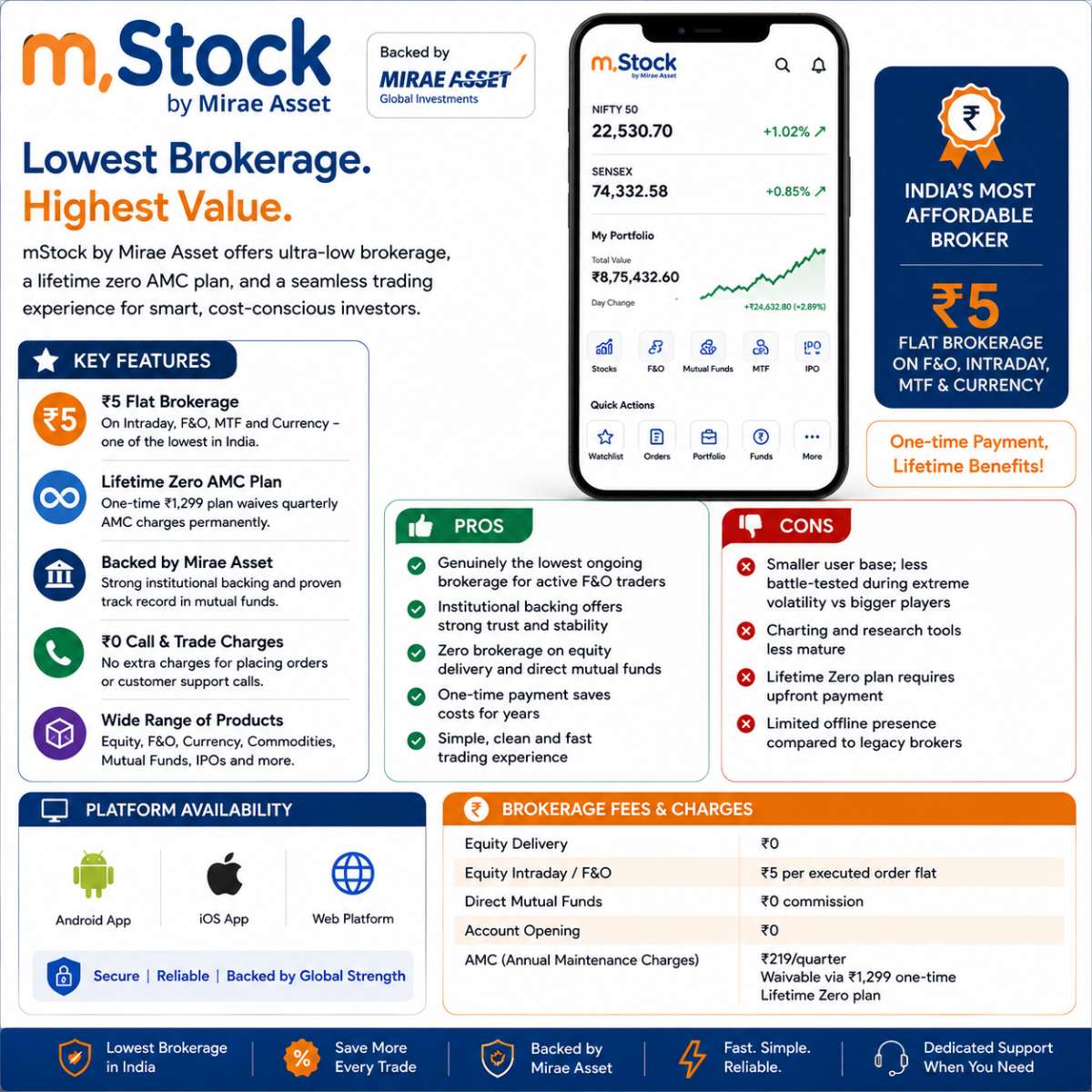
Description: m.Stock is a digital brokerage platform backed by Mirae Asset. It focuses on low-cost trading and offers a ₹5-per-order brokerage model for selected segments, along with an optional lifetime-zero-AMC plan.
Key Features:
- ₹5 flat brokerage on eligible intraday, F&O, MTF, and currency orders.
- One-time ₹1,299 Lifetime Zero plan that can waive quarterly AMC charges.
- Backed by Mirae Asset.
- ₹0 Call & Trade charges.
- Supports equity, F&O, mutual funds, IPOs, MTF, and other products.
Pros:
- Very low brokerage for active traders in eligible segments.
- Institutional backing from Mirae Asset.
- Zero brokerage on equity delivery and direct mutual funds.
- Lifetime AMC option can reduce long-term account maintenance costs.
Cons:
- Smaller user base compared with some established competitors.
- Charting and research tools may be less mature than those offered by larger platforms.
- The Lifetime Zero plan requires an upfront payment.
- May be less suitable for investors who prefer extensive offline support.
Platform Availability: Android, iOS, and Web.
Brokerage Fees:
- Equity Delivery: ₹0.
- Equity Intraday / F&O: ₹5 per executed order, flat, on eligible segments.
- Direct Mutual Funds: ₹0 commission.
- Account Opening: ₹0.
- AMC: ₹219/quarter, which may be waived through the ₹1,299 one-time Lifetime Zero plan.
Comparison
| App | Mobile | Equity Delivery | Intraday Brokerage | F&O Brokerage | Direct Mutual Funds | Account Opening | AMC |
|---|---|---|---|---|---|---|---|
| Zerodha Kite | Android, iOS | ₹0 | ₹20 or 0.03%, whichever is lower | ₹20 or 0.03%, whichever is lower | ₹0 | ₹200 | ₹300/year |
| Groww | Android, iOS | ₹0 | ₹20 flat | ₹20 flat | ₹0 | ₹0 | ₹0 |
| Upstox | Android, iOS | ₹0 | ₹20 flat/applicable percentage | ₹20 flat | ₹0 | ₹0 | ₹240/year* |
| Angel One | Android, iOS | ₹0 | ₹20 flat | ₹20 flat | ₹0 | ₹0 | Applicable after waiver period |
| 5paisa | Android, iOS | ₹0 / plan-based | ₹20 flat / lower via subscription | ₹20 flat / lower via subscription | ₹0 | ₹0 | Varies by plan |
| ICICI Direct | Android, iOS | Plan-based | Plan-based | Plan-based | Direct plans available | Varies | Varies by plan |
| m.Stock | Android, iOS | ₹0 | ₹5 flat* | ₹5 flat* | ₹0 | ₹0 | ₹219/quarter* |
*Charges, waivers, and brokerage conditions can vary by plan, segment, order type, and current pricing structure.
Which Trading App Should You Choose?
- Complete beginner, mostly mutual funds and occasional stocks: Groww.
- Active trader looking for advanced tools and education: Zerodha Kite.
- Intraday or options trader looking for advanced charting: Upstox.
- Investor who wants research and AI-powered tools: Angel One.
- High-volume trader looking for subscription-based pricing: 5paisa.
- Existing ICICI Bank customer looking for integrated banking and investing: ICICI Direct.
- Trader focused on low brokerage in eligible segments: m.Stock.
Brokerage is only one factor when choosing a broker. Investors should also consider platform reliability, research tools, customer support, order execution, product availability, and the overall cost after statutory charges.
Brokerage figures should be verified on the respective broker’s official website before opening an account. Statutory charges such as STT, GST, stamp duty, exchange transaction charges, and SEBI turnover fees may apply in addition to brokerage.